


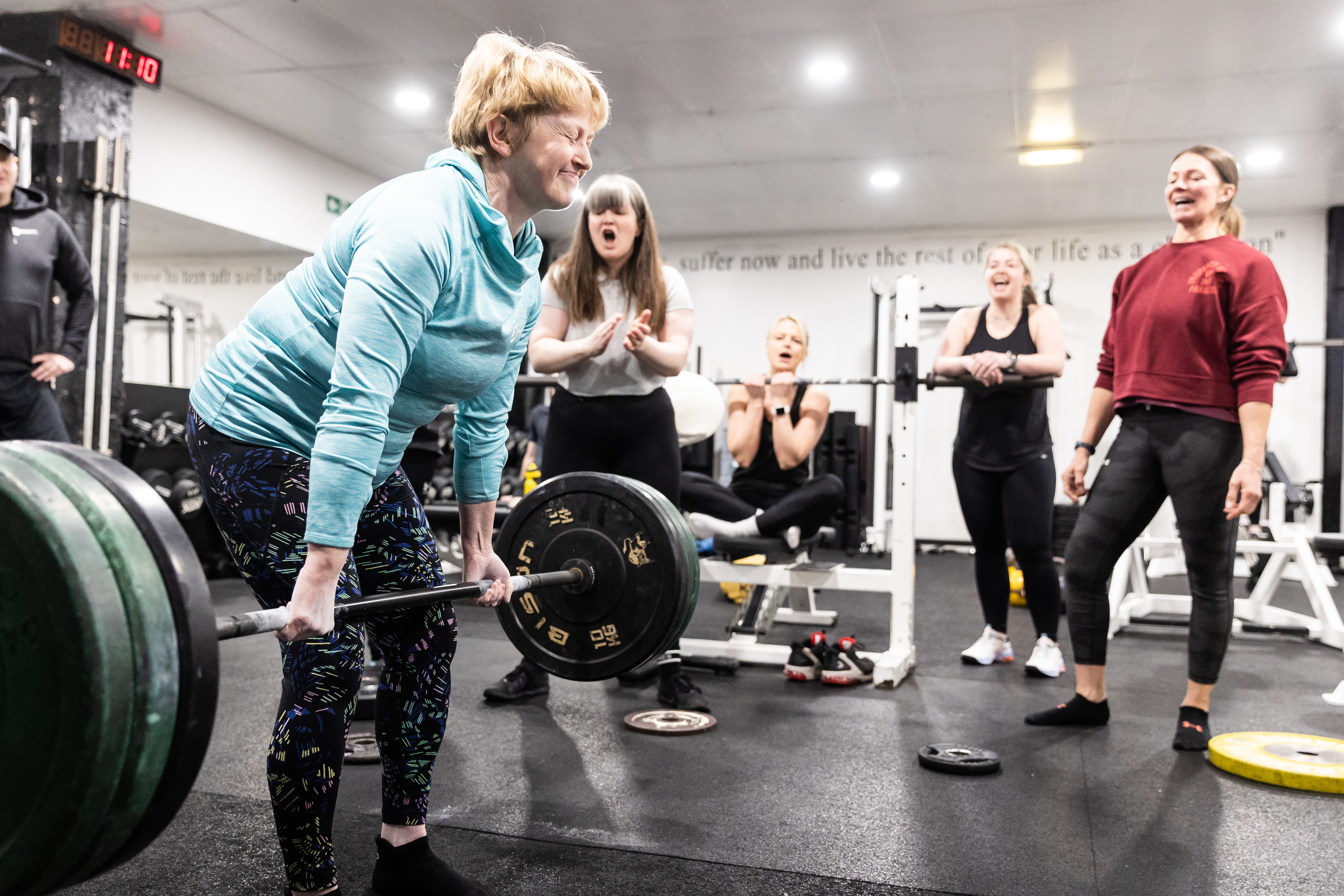
The deadlift is the ultimate measure of raw strength. But no matter how strong your legs, glutes, and back are, your lift is only as strong as your grip. If the barbell starts slipping out of your hands, your central nervous system will naturally shut down your power output to protect you. At BSPT we see lifters in our Aberdeen gym struggle with heavy pulls simply because their hands let them down. Choosing the right hand position can instantly unlock a new personal best. Here is our definitive ranking of the four primary deadlift grip variations, rated from worst to best based on effectiveness, muscle balance, and long-term lifting safety.
4. Double Overhand Grip (The Worst for Heavy Weights)
The double overhand grip is the most instinctive way to grab a barbell. You place both hands over the bar with your palms facing your body and wrap your thumbs completely around.
- The Pros: It is perfectly symmetrical. By keeping both hands identical, you ensure even muscle development across both shoulders and sides of your back. It is also the absolute best way to build raw forearm and grip endurance.
- The Cons: It is incredibly weak. As the barbell gets heavier, it naturally wants to roll down your fingers and out of your hands. Your grip strength will fail long before your lower body does.
- The BSPT Verdict: Perfect for beginners learning proper form, and great for your warm-up sets. Once the plates start piling up and the bar begins to spin, it’s time to switch.
3. Mixed Grip / Split Grip (The Most Popular Option)
With the mixed grip, you place one hand over the bar (palm facing you) and one hand under the bar (palm facing away). Generally the underhand grip is from your weaker side.
- The Pros: It is exceptionally secure. Because your hands face opposite directions, the bar cannot roll. If it rolls out of one hand, it rolls directly into the fingers of the other. This instantly allows you to lift significantly heavier weights.
- The Cons: It introduces structural asymmetry. The underhand (supinated) side places your bicep tendon under immense tension, creating a small but serious risk of a bicep tear if you try to "curl" the weight by bending your elbow. Over time, it can also lead to muscle imbalances and minor rotation in your hips, shoulders and spine.
- The BSPT Verdict: A solid option for heavy sets, but you must manage the risks. If you use this, we recommend alternating which hand faces under during your lighter sets to balance out the muscular stress.
2. Lifting Straps (The Best for Pure Muscle Growth)
Lifting straps involve wrapping heavy-duty nylon or canvas material around your wrists and threading it tightly underneath the barbell.
- The Pros: This style is virtually unbreakable. Straps completely remove your hands as the limiting factor of the lift. This allows you to focus 100% of your mental and physical energy on overloading your hamstrings, glutes, and upper back.
- The Cons: It bypasses your natural grip development. If you rely on straps for every single set, your forearm strength will fall behind. Additionally, traditional straps are illegal if you ever decide to compete in a sanctioned powerlifting competition.
- The BSPT Verdict: An invaluable tool for high-volume hypertrophy training, Romanian deadlifts (RDLs), or breaking through plateaus. We love them for auxiliary work, but try not to use them as a permanent crutch for your primary lifts.
1. Hook Grip (The Best Overall Hand Position)
The hook grip is an overhand grip with a twist. Instead of wrapping your thumb over your fingers, you place your thumb directly against the steel barbell and wrap your fingers over your thumb.
- The Pros: It gives you the perfect combination of symmetry and security. Your thumbs act as natural wedges that prevent the barbell from rolling, making it just as secure as a mixed grip or straps. Because both hands face over, it eliminates the asymmetry and bicep tear risks of the mixed grip. It is the undisputed gold standard for Olympic lifters and elite powerlifters and once perfected is virtually unbreakable.
- The Cons: It hurts—a lot. Crushing your thumbs between heavy steel knurling and your own fingers takes serious mental fortitude. It requires a painful adaptation period to desensitise the nerves and build calluses. It can also be mechanically difficult for lifters with shorter fingers. You need to be patient with it and practice it over time.
- The BSPT Verdict: The ultimate all-rounder for serious lifters. If you can push through the initial few weeks of discomfort, the hook grip offers the safest, strongest, and most balanced way to pull heavy weight off the floor. Use it in all pulling movements to get used to it.
Conclusion
Your choice of grip should ultimately match your training goals. If you are looking to build raw, balanced forearm strength, stick with double overhand for as long as possible. If your priority is packing muscle onto your back without your hands giving out, or are doing high volume sets reach for the lifting straps. But if you want to lift maximal loads safely, symmetrically, and competitively, mastering the hook grip is well worth the squeeze and a good fall bacj is the split grip. Next time you are on the platform, experiment with these variations to find what feels best for your hands. If you want a hand optimising your lifting technique, we can help. Tell us:
- What is your primary goal in the gym? (e.g., building maximum strength, general fitness, or fat loss)
- Do you currently experience any wrist or elbow discomfort when pulling?
- Would you like our trainers to show you the proper way to set up a hook grip or use lifting straps?
- Do you need help learing how to deadlift ?
Let us know, and let's get those numbers moving up safely!